DOGE Range Rebound Analysis: Price Coils at $0.10
- CopyTradia Intelligence

- Jun 2
- 5 min read
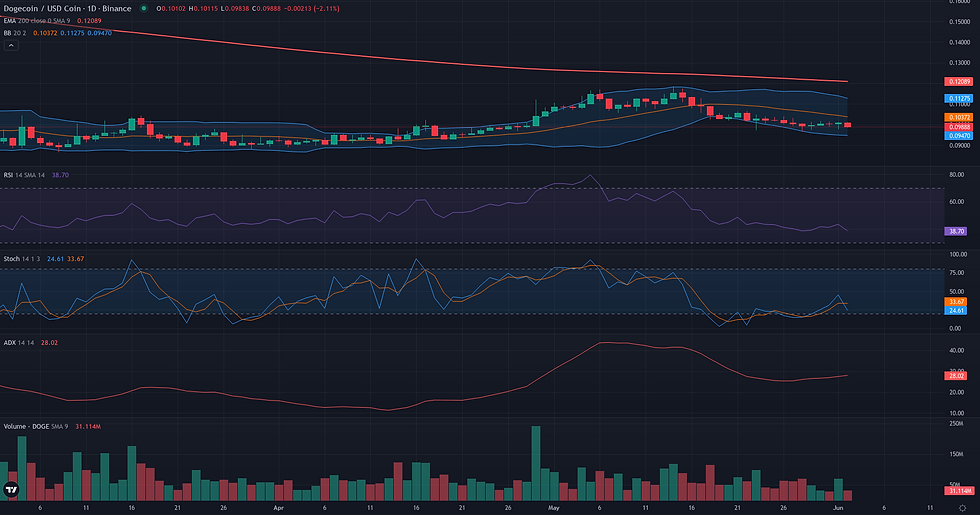
This DOGE range rebound analysis examines the current DOGE/USDC structure in the context of support defense and weakening alternative frameworks. DOGE/USDC is currently locked in a state of extreme equilibrium, with its price pinned to the $0.10 level for over two weeks. This price action has led to a significant compression in volatility, as reflected by the tight daily Bollinger Bands. The market structure shows a clear consolidation phase, but underlying momentum remains weak, with the daily RSI at 43.44 indicating a bearish tilt. The price continues to trade below key long-term moving averages, such as the 200-day EMA at $0.12, which reinforces a broader bearish context despite the recent stability. This technical stalemate aligns with the latest fundamental analysis, which points to deteriorating market sentiment and contracting volatility, suggesting a period of cautious indecision rather than directional conviction. The current structure sets the stage for a potentially sharp move once this balance is broken, making the analysis of competing technical frameworks particularly relevant.

DOGE Range Rebound Analysis: Support and Friction Zones
The Range/Rebound framework for DOGE/USDC is currently defined by an extreme state of price compression within the 0.10 - 0.11 validation zone. The market has reached a point of near-perfect equilibrium, coiled around the 0.10 level, which is reinforced by the D1 50-period EMA. This prolonged consolidation confirms the 'Range' thesis, but the potential for a 'Rebound' remains entirely speculative due to a lack of bullish momentum. The structural integrity of this framework rests on the defense of the 0.10 support. The invalidation zone is therefore defined by a failure to hold this floor; a daily close below the 0.09-0.10 area would negate the stabilization and likely trigger a continuation of the prevailing downtrend. Should a rebound attempt begin, it would face immediate friction at the top of the range around 0.11, which aligns with the weekly R2 pivot. A more significant obstacle lies at the 0.12 resistance cluster. This level represents a major confluence of the daily and weekly 200-period EMAs and the last significant swing high, making it a critical test for any bullish continuation. If buyers manage to clear this heavy resistance, the next logical projection zone would be the 0.14 area, anchored by the weekly 50-period EMA. Confirmation of the rebound requires a decisive breakout from the current inertia—specifically, a sustained move above 0.11 with rising volume and a 4H RSI climbing above 50. Conversely, a weakening of the framework would be signaled by continued stagnation at 0.10 or feeble attempts to rally that are immediately sold off, indicating that buying pressure is insufficient to absorb supply.

Breakout: Structural Catalyst Assessment
The Breakout framework is currently not plausible for DOGE/USDC. The market structure presents a significant contradiction to the core requirements of a pre-breakout scenario. While an extreme compression of volatility is evident, confirmed by exceptionally tight Daily Bollinger Bands (upper 0.11 / lower 0.09), this condition is direction-neutral and its context is overwhelmingly bearish. The primary issue is structural. A breakout setup requires price to consolidate directly beneath a well-defined resistance. Here, the key resistance is clearly identifiable around 0.12, a confluence of the Daily and Weekly 200-period EMAs and the upper Donchian channel. However, the price is not challenging this level. Instead, it has been consolidating for over two weeks at the bottom of its recent range, around 0.10. This price action is more indicative of a pause in a downtrend than an accumulation phase for an upward break. This structural weakness is compounded by bearish momentum and a hostile weekly context. The Daily RSI at 43.44 and Weekly RSI at 40.92 both signal a lack of buying pressure. Furthermore, the weekly chart shows price trading significantly below its key moving averages (W1 EMA50 at 0.14), reinforcing the dominant downtrend. For the Breakout framework to become relevant, the price would first need to reclaim lost ground and establish a new consolidation phase directly challenging the 0.12 resistance zone, accompanied by a clear shift in momentum.

Continuation: Directional Flow Assessment
The Continuation framework is assessed as not plausible for DOGE/USDC at this time. The primary reason for this conclusion is the complete absence of a directional structure on the daily timeframe, which is a prerequisite for a continuation scenario. While the weekly context remains structurally bearish, with the price at 0.10 trading below both the weekly EMA 200 (0.12) and EMA 50 (0.14), the daily chart does not show a healthy pause or pullback. Instead, it displays an extended period of extreme price compression, with price action remaining static at 0.10 for more than ten consecutive sessions. This state of consolidation is confirmed by very low volatility (NATR D1 at 4.12) and weak momentum (D1 RSI at 43.44). The current market signature is one of indecision and energy coiling, which typically precedes a volatile breakout rather than an orderly continuation. Therefore, until a clear directional breakout from this tight range occurs, the 'Stable Directional Flow' required by the Continuation framework is not present.

Comparative Framework Verdict
Comparing the three technical frameworks, the market structure for DOGE/USDC offers a clear verdict: the Range/Rebound scenario, while only borderline, is the most coherent description of the current price action. The other two frameworks, Breakout and Continuation, are both assessed as not plausible. The market has been consolidating in an extremely tight range around the $0.10 support level for over two weeks, which strongly validates the 'Range' component of the first framework. However, its plausibility is limited by a distinct lack of bullish momentum needed to initiate a 'Rebound', with the price remaining below the significant resistance cluster at $0.12. The Breakout framework is invalid because the price is consolidating at the bottom of its recent range, not compressing under the key $0.12 resistance. Similarly, the Continuation framework fails because the market is in a complete stall, lacking the 'Stable Directional Flow' it requires. This is a market defined by indecision, not a trend pause. Ultimately, the Range/Rebound framework best captures the current tension between a solid structural floor at $0.10 and a persistent bearish macro context. The key development to watch will be whether buyers can defend this support and generate enough momentum to challenge resistance, or if sellers will force a breakdown, resolving the compression to the downside.
For broader market context, readers can also review the latest related fundamental analysis for this pair.
For live market monitoring and the full interactive chart, readers can access the dedicated DOGE Market Hub.
Disclaimer
CopyTradia provides technical analysis for informational and educational purposes only. This content does not constitute financial advice, investment recommendations, or trading signals. Cryptocurrency markets are highly volatile. Past performance is not indicative of future results. Always conduct your own research (DYOR) and consult a qualified financial advisor before making any investment decisions.


